Tuesday, March 25, 2025

Film Review - Star Wars: Return of the Jedi

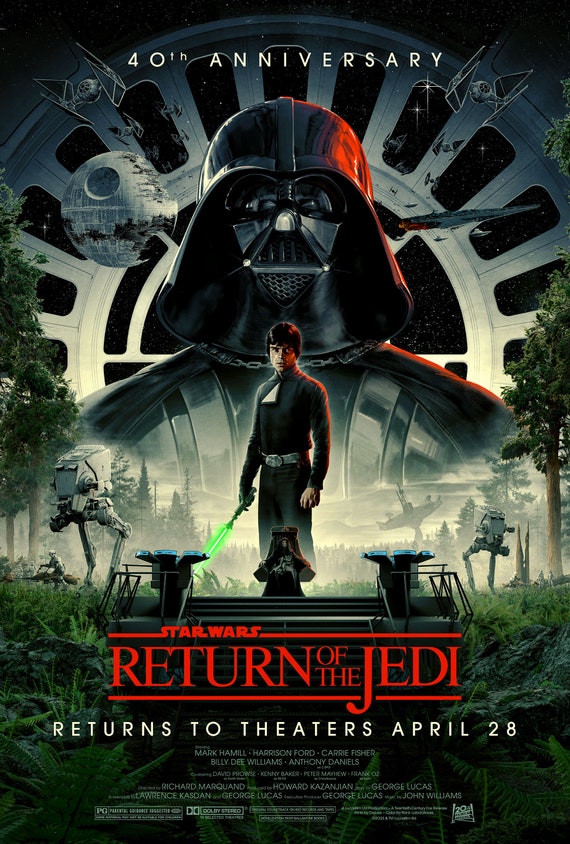
Star Wars: Return of the Jedi

Stupid Ewoks

The third and final entry of the original Star Wars trilogy, the sixth Episode of the later-named Skywalker Saga, opens with a visit by Darth Vader to the Second Death Star in the making above the forest moon of Endor, with none other than Emperor Sheev Palpatine himself overseeing its construction. The action then cuts to Luke Skywalker's home planet of Tatooine, where droids Threepio and Artoo visit crime lord Jabba the Hutt's palace as part of a plan to rescue the carbonite-frozen Han Solo, Luke himself promising the pair as a bargain.

Jabba refuses and demonstrates overall that he isn't a very competent criminal since he comes to hold several high-profile members of the Rebel Alliance prisoner, encompassing the droid duo, Han, and Princess Leia, but doesn’t demand any kind of ransom for them, seeming to hold them hostage for the sake of holding them hostage (and describing Han as his "favorite decoration" in his palace). Boba Fett returns as well, with his own spinoff Disney+ series ultimately settling his fate, though Jabba’s having a son, Rotta, in the The Clone Wars pilot film still leaves to question what became of the younger Hutt.

Luke eventually comes to the rescue and gets everyone back in the Rebellion, Lando Calrissian joining their ranks and having been a part of the plot to get everyone free, with the Rebels gradually assembling to attack the Second Death Star above Endor. Before he joins the attack, though, Luke returns to Dagobah to complete his training with antediluvian Jedi Yoda, who does an about-face and says his training is complete, given his experience with fighting Darth Vader back in The Empire Strikes Back, though to become an official member of the fallen Order necessitates he defeat the Sith Lord.

And swing it around like a kid with a wiffle bat.

Luke uses the four decades of technological progress since his dad's lightsaber was lost to build a new one and...make it green.

Obi-Wan’s Force ghost returns as well, agreeing with Yoda that Luke must confront Vader and his Sith Master the Emperor, after which comes the revelation of who the "other" the diminutive Jedi mentioned in Episode V is, and continuing the story of Luke's lineage. I know many critics and "fans" talk about the "inconsistency" of Obi-Wan not knowing of the "other hope" in Empire, although the late Jedi continues to insist that Luke is the Galaxy’s "last hope" within the film but given Kenobi’s experience with said "other hope" in his respective Disney+ series, I can semi-understand why he would feel that way.

However, Luke is hesitant to kill Vader given the iconic revelation in Episode V, believing there is still good in him, and since Obi-Wan had warned him about the young Skywalker's wish to "take the quick and easy path" to becoming a Jedi, Kenobi was pretty much going against his own advice, and had done exactly that in The Phantom Menace. Kenobi further warns that Vader is immune to redemption given that he's "more machine now than man, twisted and evil." Gee, now how exactly did that happen? Given Obi-Wan's actions before and advice to Luke, he could actually be considered one of the true villains of the Star Wars saga, too evil in fact for

Game of Thrones.

Luke is initially part of the plan to down the deflector shield protecting the Second Death Star in space, but believes he jeopardizes the mission and parts ways to allow the Imperials to capture him to meet Vader and eventually the emperor in the fledgling space station, culminating in a final duel while the Rebels deal with the trap Palpatine laid for them. The final scenes between Luke and Vader are among the most emotional in the Skywalker Saga, the Rebels down on Endor overcoming the emperor's trap with the help of the local Ewok population, after which everyone across the Galaxy celebrates their sudden obtained freedom from the Empire.

But noooooooooooooo, it's a Dark Side ability.

Luke could've just done this instead of killing everything he came across.

While I'm mostly fine with the changes effected to rereleases of the Original Trilogy, the scenes of everyone across the Galaxy including Coruscant, Tatooine, Bespin, Naboo, et all, celebrating in my mind was one I find issue with, since the Rebels just destroyed a space station and a fraction of the imperial forces, which would be akin to the destruction of the Pentagon causing America to collapse. Throughout history, furthermore, the deaths of national leaders rarely made regimes fall as well; for instance, the Ba'athist Iraqis still fought when Saddam Hussein fell out of power.

I know a trilogy of canon novels addresses what happens post-Battle of Endor, but George Lucas wasn't completely foresightful when turning Star Wars into a franchise, given the various clashes of continuity within and without the original and prequel trilogies. Regardless, Episode VI did really move me emotionally, more so than Empire, and John Williams's score as always is good and led me to fully watch the ending credits. Overall, Return of the Jedi, regardless of its faults, has aged well and is one of the cornerstones of the series.


The Good The Bad
  • Actually the most emotionally-moving entry of the Original Trilogy.
  • A lot of great dialogue and moments.
  • Great music.
  • Excellent visual effects.
  • Some dumb moments as always.
  • Questionable plot elements also.
The Bottom Line
Acutally the high point of the Original Trilogy.

Monday, March 24, 2025

Zootopia+

Zootopia+

Since I reasonably enjoyed Disney’s Zootopia, I naturally watched its spinoff Disney+ series, consisting of six short side stories parallel to the film's events. The first sees Judy Hopps’ parents try to rescue their youngest daughter among countless children, Molly, as she hitches a ride on the train that takes her older sister to Zootopia. The second sees Fru Fru the shrew participating in a reality television series while dealing with her forthcoming wedding. The third sees Duke Weaselton ponder his life choices through singing, the next one providing backstory to Mr. Big in a further nod to The Godfather. The penultimate episode features Chief Bogo and Clawhauser participating in a talent show, and the last Sam, an otter waitress, as she serves the sloth couple Flash and Priscilla. I enjoyed this mini-series overall, given its addition to the film’s events (and a few scenes from the movie are even featured), though the franchise mythos likely won't be explored further due to Disney's decision not to make any more spinoffs based on their main films.

Sunday, March 23, 2025

Debt of Bones

Debt of Bones (Sword of Truth, #0.5)Debt of Bones by Terry Goodkind
My rating: 4 of 5 stars

In author Terry Goodkind's first Sword of Truth prequel story (occurring in between the second, The First Confessor, and Wizard’s First Rule, the first main entry of the franchise), protagonist Abigail, born of Helsa, carries a sack whose contents are revealed later in the novella, going to Aydindril to seek the assistance of First Wizard Zeddicus Zu'l Zorander on account of soldiers from the D'Haran Empire, led at the time by Panis Rahl, occupying her hometown of Coney Crossing, although her plea for assistance is initially declined. Abby ultimately does get aid when she speaks of the titular debt, and she, Zedd, and others head to her village.

Abby is a "skip," the child of a magician who has no magical capability, and has a daughter, Jana, and a son that died at birth. Conflict erupts back in Coney Crossing after an initial encounter with a Mord-Sith, a torturer and assassin of the magically-inclined, with Zedd promising a country without magic for those who would prefer such a society, and the story ending with his maxim that enemies are the price of honor. Overall, this novella is an enjoyable diving board into the greater and lengthier Sword of Truth novels, although division into chapters would have been welcome.

View all my reviews

Friday, March 21, 2025

Bullshit Jobs: A Theory

Bullshit Jobs: A TheoryBullshit Jobs: A Theory by David Graeber
My rating: 4 of 5 stars

David Graeber begins Bullshit Jobs by noting that everyone is familiar with jobs that don't seem to do much of anything like human resources, communications, people who discuss unnecessary committees, and so forth. In 1930, economist John Maynard Keynes predicted that by the end of the century, technology would be sufficient to the point where the average work week would be fifteen hours, which of course hasn't been the case today. The ruling class figured out that happy and productive populations with plenty free time would be a mortal danger, with Graeber mentioning that neoliberal ideology was the opposite of what it claimed, a political project dressed up as an economic one.

The first chapter attempts to define what a bullshit job is, mentioning military contractors and subcontractors and stories such as postal carriers who decide that rather than delivering mail, they dump it into various locations, letting it go undiscovered for years. Graeber further defines bullshit jobs as forms of employment so pointless that even the employee can't justify its existence even though they feel obliged to pretend otherwise. He mentions specific forms including telemarketing, market research, consulting, that allegedly produce little positive social value. Jeffrey Sachs, the Columbia University professor that designed "shock therapy" reforms for the former Soviet Union, mentions that America's duopolizing political parties are beyond corrupt, still the case today.

The second chapter asks what kind of bullshit jobs exist, obtaining testimony from across the world. Graber indicates five varieties: what flunkies do, with examples such as managers playing Pokémon all day rather than doing meaningful things; what goons do, including soldiers that don't fight wars; what duct tapers do, like coders patching defective computer programs; what box tickers do, such as checking stuff off on checklists and bureaucrats; and what taskmasters do, including allocating tasks to others. The author makes an analogy about imaginary friends, mentioning fake advertising and compliance firms, concluding by mentioning that you can have a bullshit job without realizing it.

The third chapter explores some of the moral and psychological effects of being trapped inside a bullshit job. Graeber mentions a Brish man who worked as an Interface Administrator for a content management system, being a combination of a duct-taper and a box checker, a not-so-dream dream job. He notes that students learn five main things: how to operate under others' direct supervision, how to pretend to work even when nothing needs to be done, that one is not paid money to do things, however useful or important, that one actually enjoys, that one is paid money to do things that are in no way useful and one does not enjoy, and that at least in jobs requiring interaction with the public, even when carrying out tasks one doesn't enjoy, one has to pretend to be enjoying it.

The fourth chapter asks what it's like to have a bullshit job, Graeber saying that if being forced to pretend working is infuriating to the point where you're under another's power, then bullshit jobs are entire jobs organized on that same principle. He notes that holders of bullshit jobs aren't always miserable, but such jobs are uncommon nowadays. Graeber cites several examples, including one of Charles, who worked in Sega in "localization" but did barely any work, and Greg, who spent two years designing "annoying banner ads," among others. He concludes the chapter by stating that it's possible to find purpose and meaning even in the worst bullshit jobs.

The fifth chapter asks why bullshit jobs are proliferating, mentioning the rise of the service economy, with the simultaneous decline in industry and agriculture due to relocation to other countries, not to mention the rise of information-oriented jobs since the 1990s. One could argue that the whole financial sector is a scam of sorts, since it represents itself as largely about directing investments towards profitable opportunities in commerce and industry despite actually doing little of that. Graeber touches upon the concept of development hell in the entertainment industry, where certain media goes unproduced for years, even decades, which appealed to me as I am familiar with that term.

Chapter Six asks why society doesn't object to the growth of pointless employment, mentioning that opinion writers are modern moralists, secular equivalents of preachers, and when they write about work, their arguments reflect long theological traditions of valorizing work as sacred duties, both curses and blessings, seeing humans as lazy and inherently sinful, and such. Graeber touches upon the Puritan Gospel of Work, where those who work are happy, and mentions the rise of the Gospel of Wealth that arose in the decades following the American Civil War. He mentions the American stereotypes of laziness being affiliated with racism towards the end.

The seventh chapter inquires as to the political effects of bullshit jobs and if anything can be done about them. Graeber mentions that critics claim we aren't working fifteen-hour work weeks because we have consumerism over leisure, which isn't too off the mark, but we are working harder because we feel pain the workplace as a justification for our furtive consumer pleasures as they take up more of our working existences, a form of sadism. He calls out the Left for trying to collapse the gulf between self-interest and high-minded principles despite its main messengers being Hollywood elites, while the Right is about preserving wealth that conflicts with moral traditions like religion.

The author concludes by mentioning universal basic income as a solution to the problem of proliferating bullshit jobs, and I found that automation through AI could help ease along that process, which prominent American elites like Elon Musk support, serving as President Donald Trump's "first buddy," and as a fellow autistic to Elon, that really appeals to me. The book is really good and makes some great points that could easily apply today, although the author does get some of his facts wrong like mentioning school administrators are part of teachers' unions, and some of the references to media like Douglas Adams' books will fly over many readers' heads. Regardless, this was an illuminating read that I would highly recommend.

View all my reviews

Monday, September 5, 2022

Detective Trigger and the Big Break

Detective Trigger and the Big Break (Detective Trigger, #5)Detective Trigger and the Big Break by M.A. Owens
My rating: 4 of 5 stars

In the penultimate entry of author M.A. Owens’ Detective Trigger series, the namesake Chihuahua Detective finds himself in Arc City Prison, where he meets many prisoners whom he helped incarcerate, prime among them being the feline Mr. B, or “Mr. Scumbag” as the dog terms him. After he fights with Mr. B, the black cat Warden Beans offers Trigger undercover work throughout his prison, tempting him with freedom along with that of his friend Rick. On the surface, Trigger is set up for maintenance duty along with his imprisoned friend Marty, who becomes his cellmate.

Trigger gets into trouble with the canine floor supervisor Dan when attacked by twin cats, although Marty becomes Mr. B’s head of security whilst continuing maintenance duties. The detained detective further seeks information from Fernando, with whom he physically fights, after which a guard takes him to see Mildred and Lady, who provide him with valuable information and revelations. Lady expresses her wishes to get her hands back on the Grand Gobbler statuette, with an escape attempt occurring throughout the concluding chapters, along with a critical reversal of character allegiances, and an epilogue mentioning cybernetics.

All in all, this entry of the Detective Trigger series was an enjoyable one, with the straightforward continuation of its predecessor’s events, the cover art in particular bringing to mind one of the concluding scenes of the last book, and I had little trouble imagining the prison environment that dominates it for the most part. There is mention of the specific breeds of cats and dogs the various characters belong to, although the absence of the Kindle’s x-ray feature in the series’ six-book collection prevents reminders as to which. Regardless, I definitely don’t regret reading and look forward to seeing how the books conclude.

View all my reviews

Saturday, September 3, 2022

Fire Emblem Awakening


The Emblem Awakens

I’ll confess that I’m not a huge fan of Nintendo’s flagship franchises, among them the strategy RPG series Fire Emblem, which wouldn’t release outside Japan until the Game Boy Advance came about. I didn’t play the initial translated titles, although I felt that the Nintendo DS remake of the inaugural entry, Shadow Dragon, would be a good diving board into the franchise. How wrong I was; it ended up being one of few RPGs I ended up unable to finish, with the final battle being a wall preventing me from seeing the ending, although I did barely make it through the endgame a few years later with the partial help of the player’s guide (although there were nonetheless many tough moments).

I more or less swore off the series, and when the first title for the Nintendo 3DS, Fire Emblem Awakening, came along, I was apathetic, although when I learned that Intelligent Systems was making optional a hallmark of the franchise, the permanent death in battle of characters, I decided to give it a third chance, and luckily, it was a chance for the better. Upon starting a new game, the player has a number of options affecting the difficulty, the ability to toggle on/off permadeath among them, and creates an avatar to serve as chief deuteragonist and tactician for the player’s party, with the need to pick both a talent and a flaw for the customizable character influencing stat growth.

Awakening occurs roughly two millennia after the events of Shadow Dragon and Gaiden (which would receive the remake Shadows of Valentia), with their respective continents receiving the new names of Ylisse and Valm. The player’s amnesiac avatar, default name Robin, dreams of killing protagonist Chrom, who leads a personal army known as the Shepherds. Following this is an episodic military campaign that culminates with Chrom’s crusade against the ancient dragon Grima, with great potential for variation, many playable characters able to marry and have children, and the fates of all survivors settled during the ending credits similar to the Suikoden series.

While the characters receive decent development throughout the game, even more so with support conversations eventually triggered when units attack enemies whilst adjacent to other party members a certain number of times, the narrative clearly derives elements and twists from the Star Wars franchise, among them being a resistance against an unjust government. There is a lot of good dialogue, although the translators often made little effort to make the speech sound realistic, with the oath “Gods!”, for instance, sounding asinine when “By the gods!” would have sounded better (and is used maybe once), mayhap even “Heavens!” The voice clips accompanying many cutscenes also rarely, if ever, match the actual dialogue, and overall, Awakening is at the low end of Nintendo’s translation quality.

Luckily, given the major tweaks to the series’ signature strategic gameplay, that particular aspect is significantly more bearable than in prior installments, with the setting consisting of an overworld connected by dots indicating locations, most of which have shops where players can purchase equipment, money primarily gained from small, medium, and large gold bullions commonly acquired from slaying certain enemies in combat. Those worried about not being able to grind their characters supplementally can rest assured that additional encounters appear regularly on the overworld in between story battles, and Reeking Boxes buyable from a few merchants can trigger additional engagement opportunities, enemy strength dependent upon where the boxes see use.

As in pretty much any other game of its subgenre, Awakening sees cutscenes preceding battles, mercifully skippable in case of instances where either Chrom or Robin dies in combat, resulting in an unceremonious Game Over and a trip back to the title screen, any experience units acquired lost, largely a deterrent against the accessibility of titles of its type. Each character can carry five different items with finite uses including self-healing potions, melee or ranged weapons, offensive magic tomes with close and ranged capability, or staves with supportive effects like healing.

Characters have up to three proficiencies with various weapon types, increasing slowly up to the maximum A grade with a successful, provided an engaged enemy’s counterattack doesn’t kill the initiator of a one-on-one skirmish. Adding strategy to battles in the need to consider the “Weapon Triangle”, where sword bearers beat axe wielders, axe users have an advantage over spear-bearing units, and spears beat swords. Other elements to consider include certain weapons like bows and tomes like wind being effective against aerial units and that magic, in general, can be advantageous versus heavily-armored foes, although spells don’t seem to have their own “triangle”.

The acquisition by a unit of a hundred experience points levels them, increasing their stats, and when they reach ten, they can change into an advanced class using Master Seals, sometimes purchased from shops or gained from slain adversaries. However, it’s advisable for a unit until they reach the maximum in their base class of twenty before promotion to ensure they can acquire the highest degree of stats in their upper vocation, which in most cases has a level cap of twenty, although there are some exceptions such as dancers, useful in giving units extra turns and able to level beyond that limit.

The mechanics work well given especially the optionality of permadeath, features like two suspend save slots in the middle of combat, the ability to bring up a “danger zone” indicating if enemies can attack the player’s characters during their turn session, and skippable actions that can really shave superfluous playtime, although many players will require a fair bit of grinding in order to make it through the primary storyline campaign, leveling weaker characters can be tedious, and tasks such as exchanging items between units like keys to open chests and doors (though thief classes can do so without them) can waste the player’s time. Regardless, the gameplay was definitely a major step forward.

However, newcomers to the Fire Emblem franchise won’t exactly find it the most user-friendly strategy RPG, since the interface for the units and their respective inventories takes a lot of getting used to, and seemingly-simple tasks such as exchanging items between characters feel needlessly tedious. However, given the game’s straightforward structure, finding out how to advance the central storyline is nonproblematic, and as mentioned, the skippable attack sequences in combat can shave hours from one’s total playtime. Another nitpick, though, is that players can’t back out of shopping by using the B button alone, with the dialogue to do so needing them to use the directional pad. Overall, Awakening could have definitely interfaced better with players.

On the plus side, the soundtrack is another high point of the first 3DS Fire Emblem alongside the game mechanics, given many spectacular tracks such as the series’ central theme serving as a common motif throughout the player’s experience, the various battle themes preceded by the preparation music, and the great instrumentation and vocals that sometimes become audible, but many players will ultimately tire of hearing the character death music for the millionth time. The sound effects during cutscenes and one-on-one confrontation sequences in combat sound believable, although the voice acting, despite maybe a few strong performances, is largely lackluster, given things such as the constant grunting and dissonance with the written dialogue. Still, the game generally sounds great.

The visuals had a lot of effort put into them as well, with superb character designs that commonly appear during cutscenes, not to mention the cel-shaded anime sequences occurring at pivotal plot moments. The one-on-one skirmishes between player and enemy units look good as well, with decent colors in spite of frequent pixelation and jaggies, although the three-dimensional character models have odd proportions and the odd decision to make them appear as though they have no feet. The game, however, makes superb use of its respective system’s glasses-free 3D, and while they’re not perfect, the graphics have plenty of redeeming aspects.

Finally, the game can be a bit of a slog timewise if the player sits through every character and enemy executing their actions, but those who turn them off will mostly blaze through the game in somewhere under twenty-four hours. The different difficulty settings, potential plot differences, and the ability to carry maybe an element or two from an initial playthrough into a secondary session make for above-average lasting appeal.

On the whole, while Fire Emblem Awakening I don’t exactly consider a masterpiece, since it does have a few issues regarding the general accessibility of the strategy RPG subgenre, it was a huge step forward for the franchise, given especially the optionality of the series’ orthodox tactical mechanics, along with potential variations in the central narrative as well as solid aural and visual presentation. Granted, it does have issues regarding its unwieldy interface not to mention the derivative disposition of the storyline, but those hoping to get their feet wet in the series will most certainly find it a good starting point.

This review is based on a single playthrough of a digital copy downloaded to the player’s Nintendo 3DS.

The Good
+Accommodating to players of different skill levels.
+Great music.
+Good graphics.
+Plenty lasting appeal.

The Bad
-Can be a bit grindy.
-Controls take a lot of getting used to.
-Story immensely derivative.
-Horrid writing.

The Bottom Line:
A good turning point for the franchise.

Score Breakdown:
Platform: Nintendo 3DS
Game Mechanics: 8.0/10
Controls: 6.5/10
Story: 6.5/10
Localization: 2.5/10
Music/Sound: 8.0/10
Graphics: 8.0/10
Lasting Appeal: 9.5/10
Difficulty: Adjustable

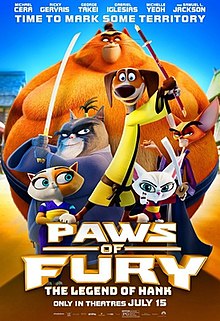
Paws of Fury: The Legend of Hank


For the most part, I’m typically in the mood for a film studded with animal characters, I found out about this animated film earlier this year, and decided to give it a watch when it appeared on Paramount+. The subtitular protagonist is a dog who finds himself a prisoner in a country where cats rule and canines are forbidden and he's appointed as samurai by a warmongering official of a town to offend its people in hopes of driving them out in order to expand his palace. Hank ultimately becomes the pupil of an ex-samurai who ruined a shogun’s birthday party years ago.

The film is basically Blazing Saddles with animals and an oriental setting (with Mel Brooks voicing the feline shogun and having some involvement with the story, along with plenty of allusion to Brooks’ early American Western parody), and Samuel L. Jackson nicely voices the ex-samurai Jimbo. The script does at times feel immature, and I don’t particularly care for toilet humor (except for the main villain’s oversized emerald latrine dubbed the “super bowl”), but it’s far from Nickelodeon’s worst movie and has a few good laughs and decent opening/ending songs.